
How a decade of bold policy, relentless entrepreneurship, and ecosystem evolution transformed India into the world's third-largest startup nation
200,000+
DPIIT-Recognized Startups
Up from 500 in 2016
125
Unicorns Created
Worth $389B collectively
17.3L
Direct Jobs Created
~11 jobs per startup
#3
Global Ranking
After USA & China
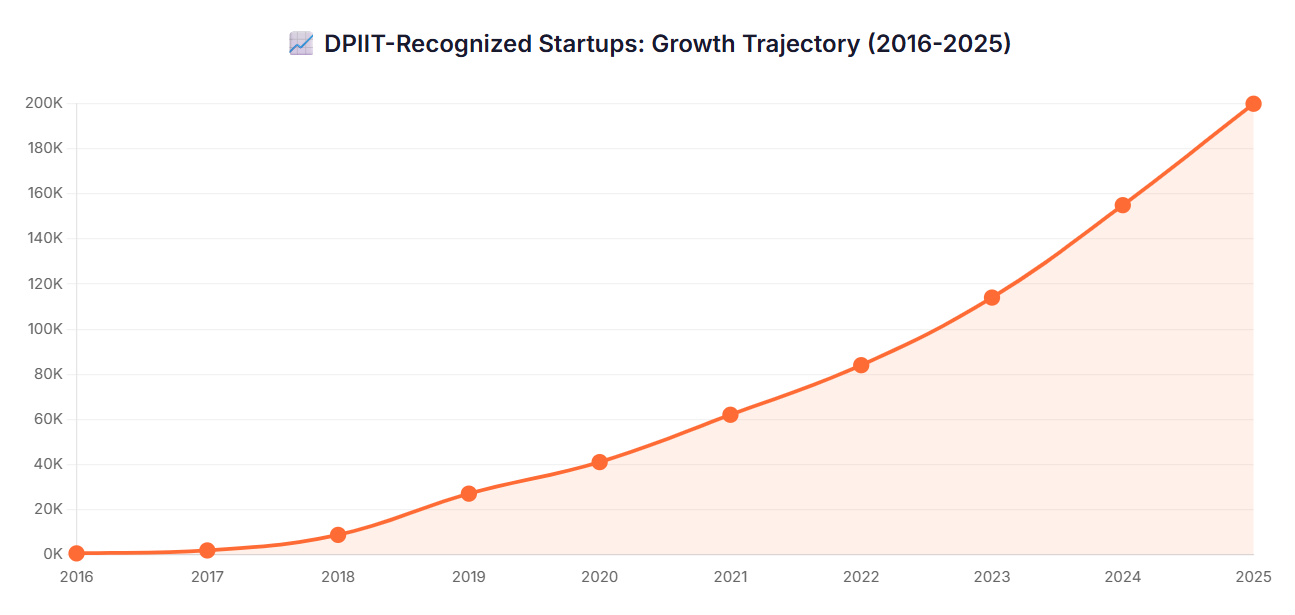
What began as an ambitious policy announcement by Prime Minister Narendra Modi on January 16, 2016, has evolved into one of the most remarkable economic transformations in modern history. The initiative grew from approximately 500 recognized startups to over 200,000, maintaining a compound annual growth rate of 115% through 2024—with roughly 80 new startups receiving recognition daily.
The funding trajectory mirrors the ecosystem's maturation through boom, correction, and recovery. From $10 billion in 2018 to a peak of $42 billion in 2021, followed by a 67% correction during the 2022-2023 funding winter, to a resilient recovery stabilizing at $11-14 billion annually with fundamentally stronger unit economics.
.webp)
📊 Peak Year Funding (2021): $42 Billion
🔄 Recovery Funding (2024) : $12-14 Bn
🏠 Domestic VC Share (2024) : 45%
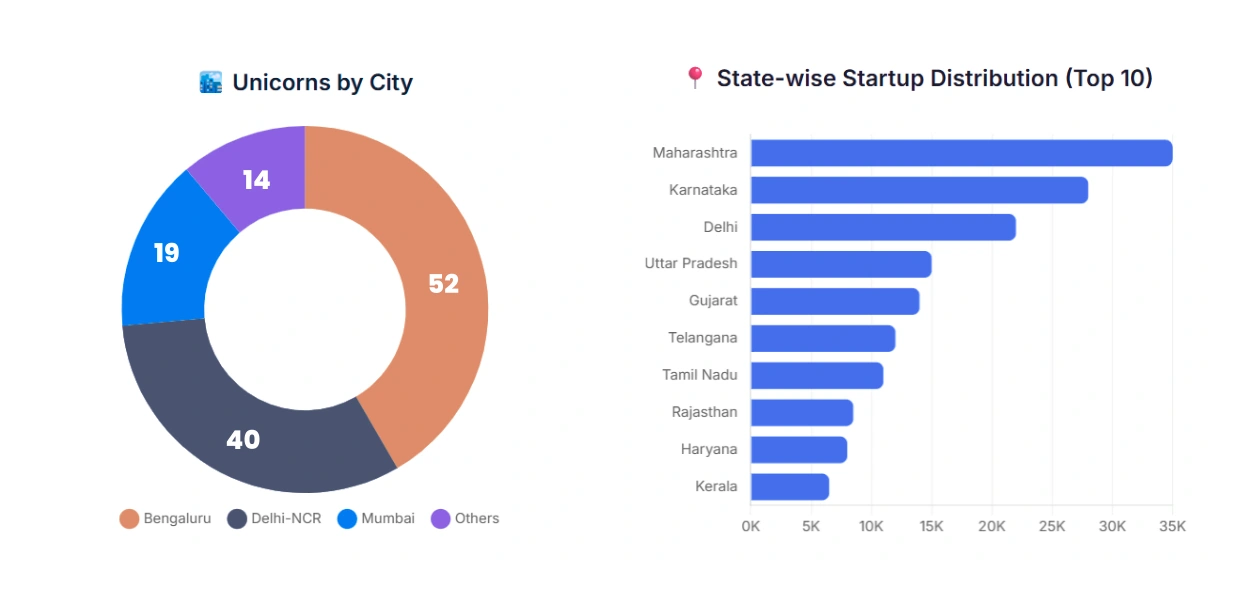
Perhaps the most transformative shift has been the geographic redistribution of startup activity. In 2016, startups concentrated almost exclusively in Bangalore, Delhi-NCR, and Mumbai. By 2025, over 50% of DPIIT-recognized startups emerge from Tier 2 and Tier 3 cities—spanning 770 districts across India.
🌟 Emerging Startup Hubs
Tier 2/3 cities offer 30-50% lower operational costs than metros. Hyderabad saw 160% funding increase in 2024. Chennai is now "India's SaaS Capital." Pune has raised $5.1B since 2014. Jaipur hosts 7,100+ startups.
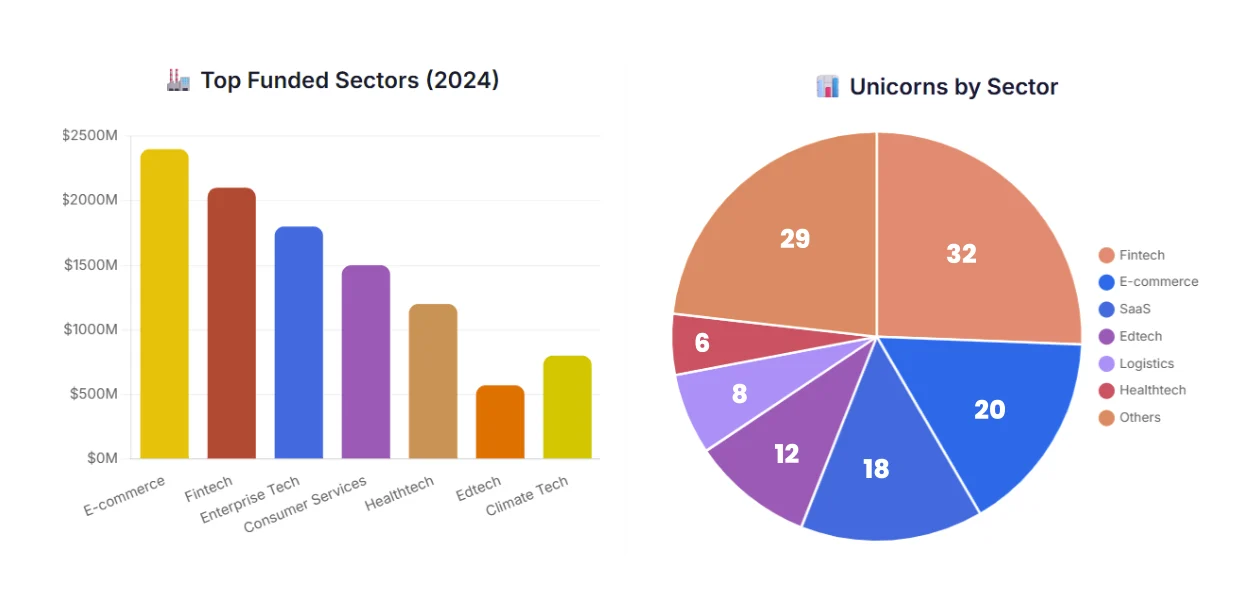
The decade witnessed distinct sectoral phases. E-commerce dominated 2016-2018, fintech and edtech surged 2019-2021, and the post-2022 landscape shifted decisively toward B2B, SaaS, and deep tech. India is now recognized as the world's second-largest SaaS hub with 30,000+ companies.
🤖 AI/GenAI Startups : 890+
☁️ SaaS Companies : 30,237
🌱 Climate Tech Funding (2024) : $2.6 Bn
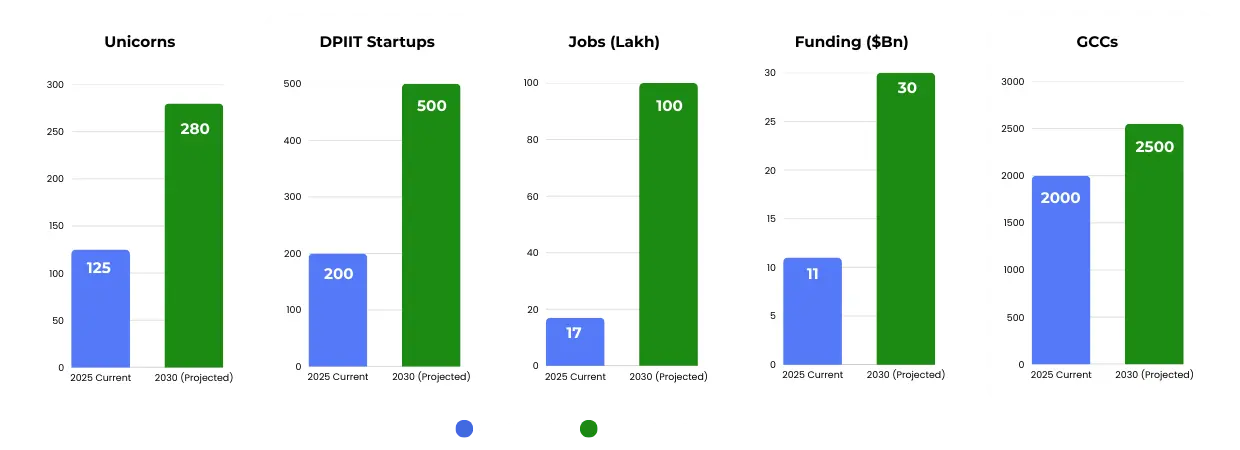
Expert projections suggest India's startup ecosystem's best years lie ahead. With 250+ unicorns expected by 2030, a potential $1 trillion contribution to GDP, and emerging sectors like AI, space tech, and climate tech gaining momentum, India is well-positioned to challenge for the #2 global spot.
🦄 Unicorns by 2030 : 250-280
💹 GDP Contribution: $1 Trillion
👥 Potential New Jobs : 50-100M
.webp)
Deep Tech Surge: From <5 unicorns today to 30+ by 2030 in AI, IoT, semiconductors
Space Economy: Targeting $44B by 2030 with 400+ private space companies
GCC-Startup Convergence: $1 trillion opportunity as 2,000+ GCCs collaborate with startups
Demographic Dividend: Median age of 28.4 years providing tailwinds through 2047
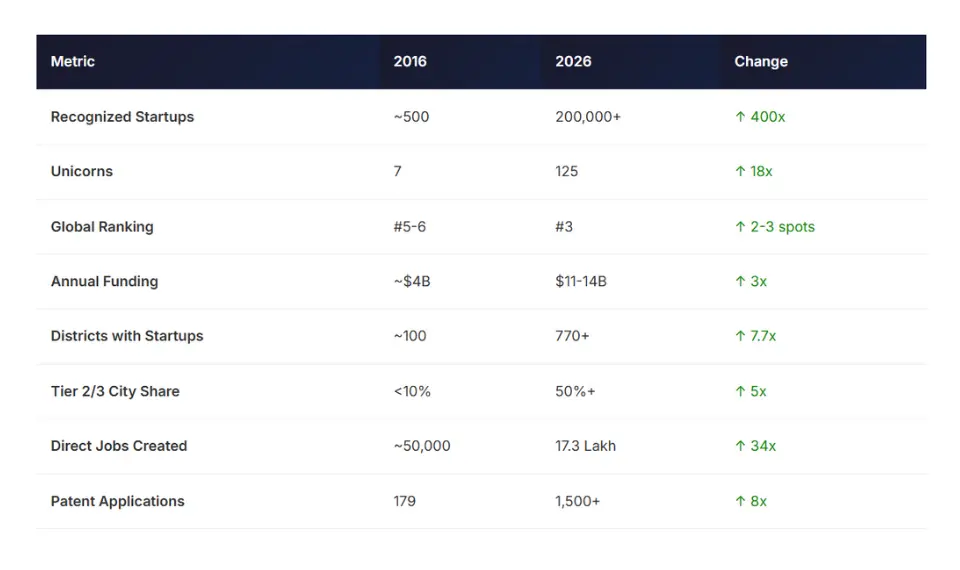
The Startup India decade has proven that policy, capital, talent, and entrepreneurial energy can combine to create an innovation ecosystem at global scale. As we enter the second decade, the foundation built since 2016 supports not just continuation but acceleration of India's entrepreneurial transformation.
Hiring great talent is no longer about transactions — it’s about transformation.
Zyoin invites you to experience a new era of hiring — where every search is powered by data, every conversation adds value, and every placement builds your organization’s future.
Because with Zyoin, hiring smarter isn’t the future — it’s the standard.